Inventory Centralization: The Key to Managing Multiple Warehouses Efficiently
10min read
Nov 11, 2025
Quick Summary
Running one warehouse is complex. Running three, five or ten warehouses across states, countries and sales channels is a supply chain balancing act. One wrong stock count, one delayed pick list, or one un-synced channel can trigger backorders, cancelled orders, or expensive emergency transfers. That is why growing eCommerce brands and 3PL operators are shifting […]
Running one warehouse is complex. Running three, five or ten warehouses across states, countries and sales channels is a supply chain balancing act. One wrong stock count, one delayed pick list, or one un-synced channel can trigger backorders, cancelled orders, or expensive emergency transfers.
That is why growing eCommerce brands and 3PL operators are shifting from spreadsheet-driven warehouse control to a centralized inventory system. Instead of hoping every warehouse, channel and marketplace stays in sync, businesses now use one platform that unifies inventory, orders, and fulfillment in real time.
This article breaks down why inventory centralization is the foundation of profitable scaling, what to expect from the right multi channel inventory management software, and how it unlocks faster fulfillment, lower stockouts, and higher supply chain efficiency.
Most multi-location businesses do not struggle because they lack stock. They struggle because they lack visibility. Inventory sits in different systems, different spreadsheets, or inside a warehouse that updates once per day, not once per minute.
The result:
One channel sells stock the warehouse no longer has
One warehouse overbuys because it cannot see surplus at another location
You ship from the wrong warehouse and pay higher freight
Fulfillment teams pick based on outdated allocations
Operations teams make decisions blind instead of based on live data
These are not “mistakes.” They are symptoms of disconnected systems.
Why Centralization Matters for Multi-Warehouse Teams
A centralized inventory control layer solves the core issue: every channel and every warehouse works off the same real-time data. Whether you sell on Amazon, Walmart, Shopify, TikTok Shop, or wholesale portals, the system updates quantities at the same moment an order is placed or picked.
With true multi-warehouse inventory management, you get:
One system instead of five disconnected platforms
Live inventory counts across every warehouse, channel and fulfillment node
Automatic safety stock allocation based on demand trends
Fulfillment routing that selects the best warehouse for cost and speed
Elimination of overselling, duplicate POs and cross-warehouse confusion
You stop managing inventory. You manage growth.
What to Look for in the Best Multi Channel Inventory Management Software
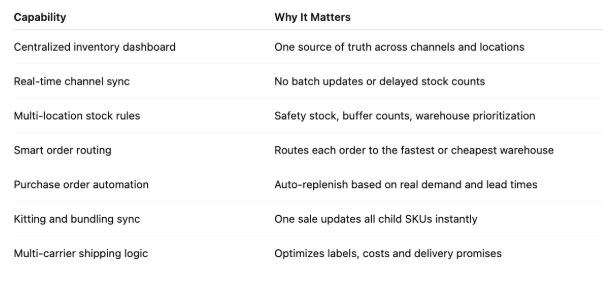
Not all platforms claiming to “centralize” inventory actually unify data. If you operate multiple warehouses, ensure your platform delivers:
If a tool only pushes updates every 30 minutes, it is not a centralized system. It is a lagging system.
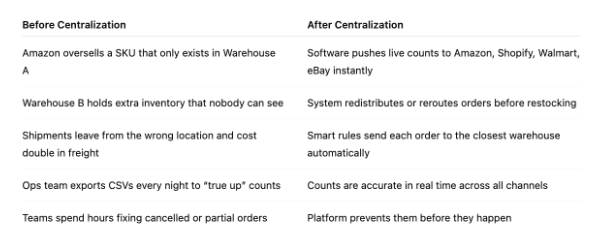
What Does Centralized Inventory Look Like in Action?
Here is a real-world example:
This is the difference between reactive fulfillment and predictive fulfillment.
Centralized Inventory System = Order Fulfillment Optimization
Once inventory is unified, fulfillment becomes faster and cheaper.
A strong platform supports:
Auto-mapping SKUs from every channel into one master SKU
Smart warehouse routing based on geography, carrier cost or SLA
Automated pick, pack and ship workflows
Live tracking data pushed back to the selling channel
Inventory holds for high-priority sales channels (like Amazon Prime or DTC VIPs)
That is order fulfillment optimization in practice. You lower cost per order while increasing delivery speed.
Supply Chain Efficiency Comes from Data, Not Guesswork
When you know what is in stock, where it sits, and how fast it moves, you can finally make intelligent decisions such as:
Which warehouse needs replenishment first
Which SKUs are overstocked and burning capital
Where to reduce safety stock without risking stockout
When to shift orders to 3PL vs in-house fulfillment
Which channels cause the highest return volume
This is how a centralized platform turns “inventory management” into supply chain efficiency.
Why Brands and 3PLs Choose Solid Commerce
Solid Commerce was built for growing brands, multi-warehouse sellers and fulfillment operators that need performance, not patchwork. With Solid Commerce you get:
Real-time inventory visibility across channels, SKUs and warehouses
One platform for Amazon, Walmart, Shopify, TikTok Shop, eBay, Target Plus and more
Automated order routing, carrier selection and shipping label generation
Centralized PO management and demand-driven replenishment
Multi-warehouse reporting that highlights margin leaks and high-velocity SKUs
This is not spreadsheet consolidation. This is unified control.
Final Takeaway
If you are still managing inventory in multiple systems, you will always be reacting to problems instead of preventing them. Centralized inventory is not a “nice to have” for companies with multiple warehouses. It is the foundation of reliable fulfillment, accurate forecasts and profitable scaling.
Your competitors that centralize faster will fulfill faster, oversell less, and carry less overhead. The question is not whether to centralize, but how soon you want the advantages.
Want full visibility and control across every warehouse, channel and SKU?
Book a Solid Commerce demo today and see how multi-warehouse, multi-channel inventory centralization works in real time.
No spreadsheets. No system stitching. Just one platform that keeps every warehouse, every channel and every order aligned.